Why Leetcode-Style Interviews Don't Measure Modern Engineering Skills | Batonship
Leetcode tests what you memorized. But 90% of engineering is orchestrating AI, fixing broken code, and adapting to change. Here's why traditional coding interviews miss the mark.
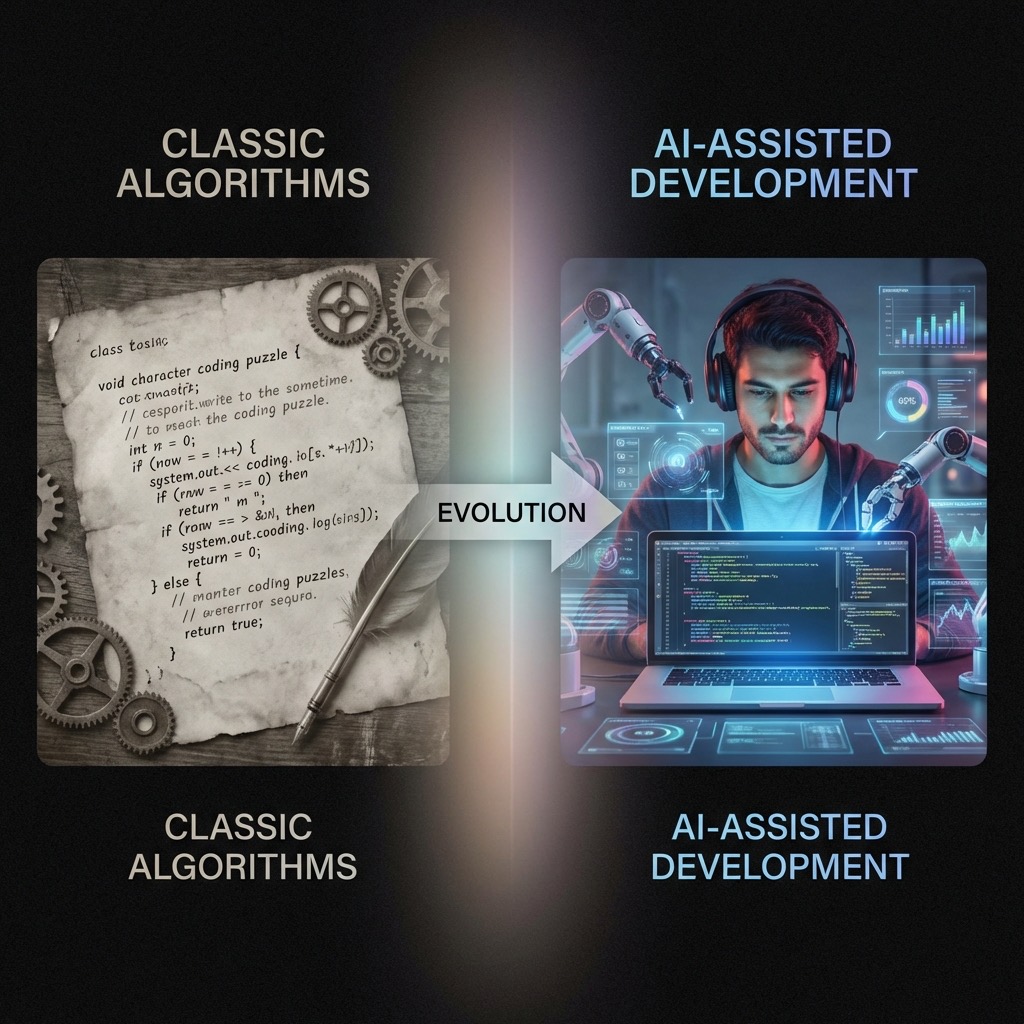
Summary: Leetcode-style interviews measure algorithmic thinking and computer science fundamentals—critical skills for any engineer. But they don't measure the 90% of modern engineering work that involves orchestrating AI tools, debugging existing systems, providing context to agents, and adapting when requirements change mid-sprint. It's time we measured what actually predicts job performance.
When Did You Last Implement Dijkstra's Algorithm?
Let me guess: probably never in production.
Yet every week, thousands of software engineers spend their evenings grinding LeetCode, memorizing graph traversal algorithms and dynamic programming patterns they'll never use on the job.
Meanwhile, their actual workday looks like this:
- Reading someone else's undocumented code
- Asking Claude to explain a confusing function
- Using Copilot to implement a feature based on existing patterns
- Debugging why a test is failing in CI
- Adapting a half-finished implementation when requirements change
- Reviewing AI-generated code for subtle bugs
The disconnect is absurd. We're testing skills from 2015 to hire for jobs in 2025.
What Leetcode-Style Interviews Actually Measure
Let's be clear: Leetcode/DSA interviews aren't useless. They measure real skills:
- Algorithmic thinking: Can you decompose problems into logical steps?
- Data structure knowledge: Do you understand arrays, trees, graphs, and when to use each?
- Complexity analysis: Can you reason about time and space trade-offs?
- Problem-solving under pressure: How do you think when stressed?
These are foundational. Computer science fundamentals matter. Algorithmic thinking is the bedrock of engineering.
But here's the problem: These skills are the starting line, not the finish.
When you hire an engineer who aces your Leetcode round, you've verified they can think algorithmically. You haven't verified they can ship.
What Leetcode Interviews Don't Measure
The job posting says "3+ years experience with modern development tools." The interview tests algorithms from a 1980s CS textbook. What's missing?
1. AI Collaboration Skills
The Reality: Engineers spend hours every day working with AI assistants.
- Copilot suggests code completions
- ChatGPT explains error messages
- Claude refactors complex functions
- Cursor generates entire implementations
What We Don't Test: Can candidates effectively orchestrate these tools?
- Do they provide clear, specific prompts?
- Do they include relevant context (error logs, related files)?
- Do they verify AI outputs or blindly accept them?
- Can they coordinate multiple AI tools efficiently?
The Leetcode Gap: You can ace LeetCode and still copy-paste AI code without reading it. You'll pass the interview. You'll fail in production.
2. Working With Existing Codebases
The Reality: 90% of engineering work is modifying existing code, not writing from scratch.
Real tasks look like:
- "This function is throwing a null pointer error in production. Find and fix it."
- "Add pagination support to this 2-year-old API endpoint."
- "Refactor this module to use our new authentication system."
What We Don't Test: Can candidates navigate unfamiliar codebases?
- How efficiently do they explore file structures?
- Can they use LSP (go-to-definition, find-references) to trace dependencies?
- Do they read related code before making changes?
- Do they understand the existing architecture before proposing solutions?
The Leetcode Gap: LeetCode gives you a blank slate. Real engineering gives you 50,000 lines of legacy code written by someone who left the company.
3. Verification Habits
The Reality: AI tools make mistakes. Copilot suggests buggy code. Claude misses edge cases. The difference between a junior and senior engineer is verification.
What We Don't Test: Do candidates verify before shipping?
- Do they run tests after AI generates code?
- Do they manually review AI suggestions before accepting?
- Do they validate edge cases and error handling?
- Do they check for security vulnerabilities?
The Leetcode Gap: In a timed DSA interview, there's no AI to verify. In production, there's AI generating code every day—and nobody's checking if the candidate has a "verify first" mindset.
4. Adaptability to Changing Requirements
The Reality: Requirements change. Stakeholders pivot. Edge cases emerge mid-implementation.
Real scenarios:
- "Actually, we need to support OAuth 2.0, not just basic auth."
- "The API response format changed—can you update your integration?"
- "We're deprecating that library. Migrate to this one instead."
What We Don't Test: How do candidates respond to change?
- Do they panic or systematically adapt?
- Can they preserve working progress while pivoting?
- Do they communicate changes clearly to their team (or AI pair)?
- How efficiently do they research new requirements?
The Leetcode Gap: The optimal binary search tree problem doesn't suddenly become a trie problem halfway through. But real tickets do change scope.
5. Context Provision
The Reality: The best engineers know what information is signal vs. noise.
When debugging:
- They share relevant error logs, not entire terminal output
- They reference related files, not dump the whole codebase
- They describe what they've already tried
- They provide reproduction steps
What We Don't Test: Can candidates provide effective context?
- To AI assistants (for better responses)?
- To teammates (in code reviews or bug reports)?
- To documentation (when writing onboarding guides)?
The Leetcode Gap: You solve LeetCode alone. You ship production code with a team—and increasingly, with AI agents who need good context to help effectively.
The False Positive Problem
Here's the painful truth: Leetcode interviews have a false positive problem.
You've hired that engineer who crushed your system design round, optimized the graph traversal in real-time, and confidently explained time complexity trade-offs.
Three months later, they're underperforming. Why?
- They can't debug the existing monorepo. They only know greenfield implementations.
- They blindly accept Copilot suggestions without reading them. Half their PRs introduce bugs.
- They panic when a product requirement changes mid-sprint. They lack adaptability.
- They over-engineer simple tasks because they're optimizing for algorithmic elegance, not pragmatic shipping.
The Leetcode interview told you they can think algorithmically. It didn't tell you they can ship effectively in an AI-assisted, fast-moving, real-world engineering environment.
That's a false positive.
The False Negative Problem (Even Worse)
Worse than false positives? False negatives.
You've rejected brilliant engineers who:
- Ship features faster than anyone on your team when using AI tools
- Have exceptional debugging intuition in messy codebases
- Verify AI outputs religiously and catch bugs before they hit production
- Adapt seamlessly to requirement changes
- Provide perfect context to agents and get 10x better results
But they couldn't invert a binary tree on a whiteboard under pressure.
You filtered them out. Your competitor hired them. They're outperforming your "LeetCode champions."
This is the talent you're missing when you rely solely on Leetcode.
What Should We Measure Instead?
I'm not saying eliminate Leetcode interviews. Algorithmic thinking matters.
I'm saying Leetcode alone isn't enough. You need to measure the skills that actually predict on-the-job performance in 2025:
The 5 Dimensions of Modern Engineering
1. Prompting Quality How clearly and specifically does the candidate communicate with AI? Can they articulate constraints, provide examples, and iterate on responses?
2. Context Provision Does the candidate share relevant information (error logs, related files) or dump noise? Do they understand what's signal?
3. Agent Orchestration How efficiently do they coordinate AI tools, terminal commands, and LSP navigation? Do they delegate effectively or micromanage?
4. Verification Habits Do they verify AI outputs before shipping? Run tests? Manually review code? Or blindly accept suggestions?
5. Adaptability When requirements change mid-task, how quickly do they pivot? Do they preserve progress or start over? How clearly do they re-plan?
These are the skills that separate productive engineers from "prompt jockeys." And traditional Leetcode interviews measure exactly zero of them.
What This Looks Like in Practice
Imagine an assessment that works like this:
-
Broken Repo Challenge: Drop the candidate into a realistic codebase with a bug. They have full access to AI tools, terminal, and LSP. Measure how they explore, debug, provide context to AI, and verify their fix.
-
Feature Implementation: Ask them to add a feature to an existing system. Mid-assessment, inject a requirement change. Measure adaptability and orchestration efficiency.
-
Code Review Challenge: Show them AI-generated code with subtle bugs. Measure verification instincts and code quality judgment.
This mirrors the actual job. And it measures the skills that Leetcode interviews ignore.
The Complementary Approach
Leetcode interviews aren't the enemy. They're incomplete.
The ideal hiring process includes:
| Interview Type | What It Measures | When to Use |
|---|---|---|
| Leetcode / DSA | Foundational CS knowledge, problem decomposition | All engineering roles |
| System Design | Architectural thinking, trade-off analysis | Senior+ roles |
| AI Collaboration Assessment | Real-world engineering skills with modern tools | All roles (especially critical for IC3+) |
| Behavioral | Communication, culture fit, growth mindset | All roles |
Together, these signals give you a complete picture.
Alone, Leetcode tells you if someone studied computer science. Combined with AI collaboration assessment, you know if they can actually ship in your modern engineering environment.
FAQ
Doesn't testing with AI just measure "prompting"?
No. Effective AI collaboration requires orchestration (coordinating multiple tools), context provision (knowing what information to share), and verification (catching AI mistakes). These are engineering skills, not "just prompting."
Won't candidates just let AI do all the work?
That's the point—we measure HOW they use AI. Do they blindly accept outputs (red flag) or systematically verify (green flag)? Do they provide good context or dump noise? Using AI is expected; using it well is the skill being tested.
Isn't this unfair to candidates who don't use AI tools regularly?
We're hiring for the job as it exists today. If your role involves using AI daily, the interview should test that skill. Just as we don't avoid testing Git because some candidates haven't used version control, we shouldn't avoid testing AI collaboration because it's new.
What if someone is great at DSA but bad with AI?
Then they have strong fundamentals but need coaching on modern workflows. That's valuable feedback. Maybe they're a great fit for roles with less AI tooling. Or maybe you invest in training them—but you made an informed decision.
What if AI tools change in 6 months?
The underlying skills (prompting clarity, verification habits, adaptability) are tool-agnostic. Whether it's Copilot, Cursor, or Claude, the principles remain. Just as DSA fundamentals transcend specific languages, AI collaboration skills transcend specific AI tools.
Conclusion: It's Time to Measure What Matters
Leetcode-style interviews have served us well for two decades. They measure real, foundational skills.
But the job has evolved. Engineers don't write code in isolation on whiteboards anymore. They orchestrate AI tools, navigate complex codebases, adapt to changing requirements, and ship—fast.
If we're hiring for the engineering job of 2025, we need to test the skills that actually predict success in 2025.
That means supplementing Leetcode with assessments that measure:
- AI collaboration effectiveness
- Codebase navigation and debugging
- Verification habits and code quality judgment
- Adaptability to change
The engineers who excel at these skills will outship your LeetCode champions 10-to-1. It's time our interviews reflect that reality.
Ready to Assess Real Engineering Skills?
Batonship measures what Leetcode interviews miss: the practical AI collaboration skills that define productive engineers in 2025. Our assessments quantify prompting quality, context provision, agent orchestration, verification habits, and adaptability—giving you a complete signal beyond algorithms alone.
Join the Batonship waitlist to start assessing candidates on what actually predicts job performance.
About Batonship: We're building the quantified standard for AI coding skills—the missing complement to Leetcode/DSA interviews. Learn more at batonship.com.
Ready to measure your AI coding skills?
Get your Batonship Score and prove your mastery to employers.
Join the WaitlistRelated Articles
The Invisible Skills of Great Engineers | Batonship
The skills that make developers valuable are now invisible in the output. Two engineers can produce identical code—only one demonstrated mastery. Here's the problem that defines hiring in the AI era.
Hiring in the AI Era: Why Process Matters More Than Output | Batonship
The way software gets built has changed. Here's why hiring teams need to assess how candidates work with AI—not just what they produce.
The Hiring Gap in the AI Era: Why Technical Interviews Haven't Caught Up
97% of developers use AI daily. Most interviews ignore this entirely. Here's why that gap matters and what 'AI coding skill' actually means.